
What causes flavor drift in cannabis products is a question many brands only ask after customers start noticing something feels off. The product still passes testing. The formulation hasn’t changed on paper. Yet the experience no longer matches what launched.
Flavor drift rarely shows up as a single failure. It emerges gradually, across batches, formats, or time on shelf. Because it is subtle at first, teams often misdiagnose the cause or treat it as a one-off issue rather than a systemic one.
Understanding flavor drift requires stepping back from individual ingredients and looking at how heat, time, formulation structure, and variability interact. Once those forces are visible, the patterns become easier to recognize and prevent.
What Flavor Drift Actually Is
Drift Is Not the Same as Batch Variation
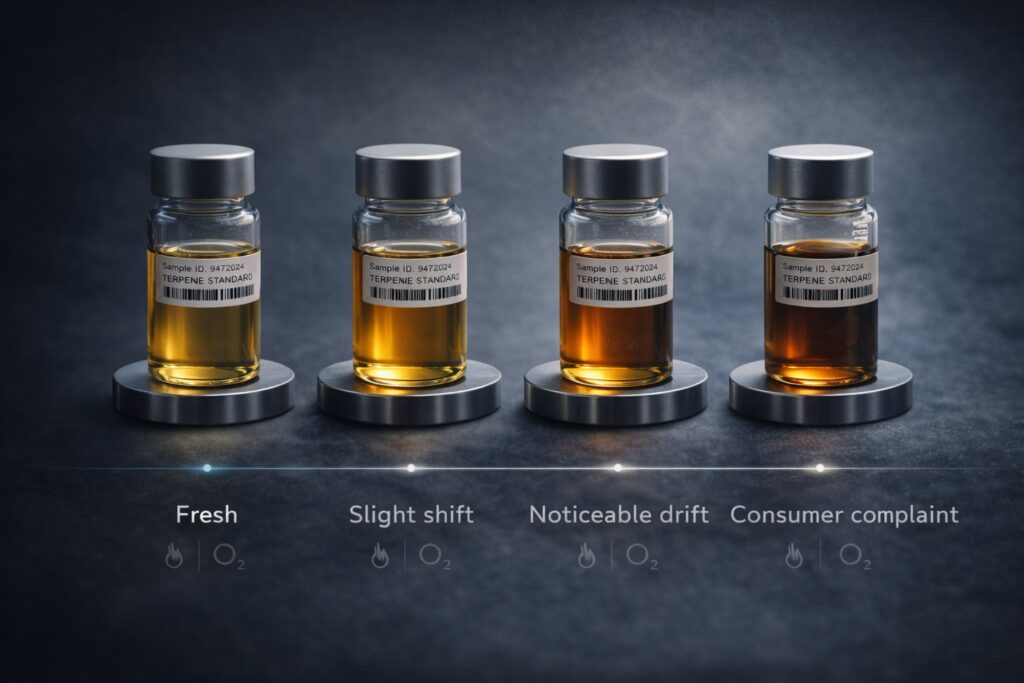
Flavor drift describes a directional change in how a product tastes over time. It is not a random fluctuation from batch to batch.
When drift occurs, each iteration moves slightly further away from the original experience. No single change feels dramatic, but the cumulative effect becomes noticeable.
This distinction matters because drift points to a structural issue, not a quality control slip.
Drift Often Appears Gradually
Most flavor drift does not trigger alarms. Early signs show up as muted aroma, flatter mid-notes, or a shorter flavor window.
Because these changes feel incremental, teams may attribute them to subjective perception rather than underlying causes.
By the time drift becomes obvious, multiple contributing factors are usually involved.
Flavor Drift Can Occur Without Formula Changes
One of the most frustrating aspects of flavor drift is that it often happens without intentional reformulation.
Inputs remain the same. Ratios remain the same. Documentation remains unchanged.
What changes are conditions: heat exposure, storage time, minor input variability, or interaction effects that accumulate across runs.
Consumers Experience Drift as Inconsistency
Consumers rarely describe flavor drift using technical language. Instead, they say products “taste different,” “used to be better,” or “feel inconsistent.”
These signals are easy to dismiss individually. Taken together, they point to drift.
Left unaddressed, drift erodes trust even when products remain compliant.
Drift Is a Systems Problem
Flavor drift does not belong to one ingredient or process. It emerges from systems interacting under real-world conditions.
Understanding those systems is the first step toward controlling drift rather than reacting to it.
The causes are rarely mysterious once they are mapped.
Heat Exposure and Volatility Loss
Flavor Drift Is Often a Heat Story
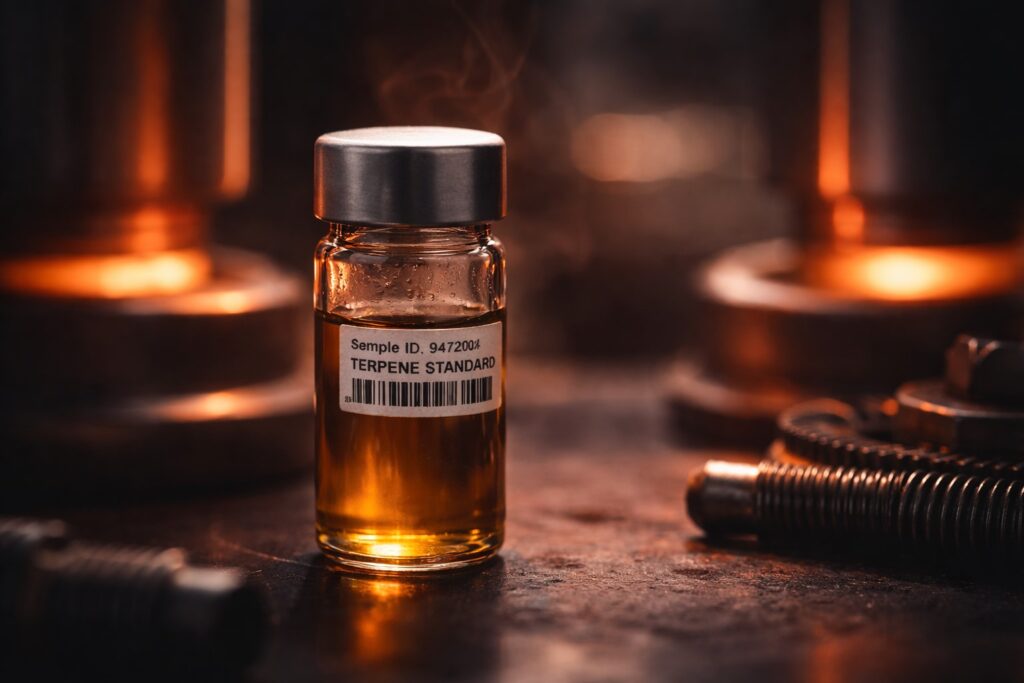
Across cannabis product categories, heat is the most common and least understood driver of flavor drift. Terpenes are volatile by nature, which means repeated or prolonged heat exposure slowly reshapes how they express.
What makes heat-related drift difficult to diagnose is that no single step usually causes failure. Instead, flavor erodes incrementally as products move through real-world production and use.
Cumulative Heat Exposure Adds Up
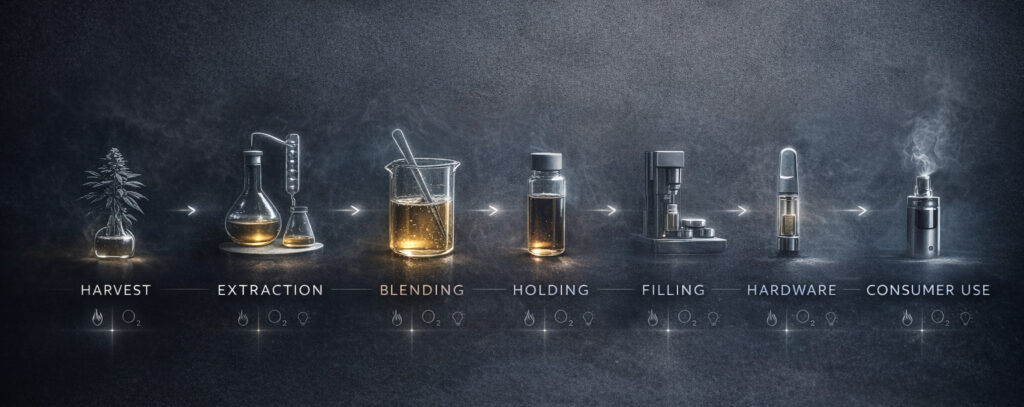
Most formulations encounter heat multiple times before reaching consumers. Decarboxylation, blending, holding, filling, and even post-packaging conditions introduce thermal stress.
Each exposure may fall within acceptable temperature ranges on its own. Together, they compound.
Over time, lighter aromatic fractions volatilize first, leaving heavier components behind. The result is a flatter, less dynamic flavor profile.
Why Vapes Reveal Drift Faster
Vape products often show flavor drift earlier than other formats because vaporization magnifies volatility loss.
Modern hardware operates across precise temperature ranges that expose imbalances quickly. Sharp top notes burn off early in a session, while mid and base notes struggle to carry the experience.
What begins as subtle thinning eventually becomes noticeable inconsistency.
Edibles and Concentrates Are Not Immune
Edibles and concentrates experience different heat pathways, but the effect is similar. Multiple heating steps during infusion, cooking, or post-processing gradually alter terpene balance.
Because these changes happen upstream, they often go unnoticed until products sit on shelves or reach consumers.
By then, the drift is already baked in.
Temperature Alone Does Not Tell the Full Story
Heat-related drift is not just about peak temperature. Time, exposure duration, and oxygen presence all influence volatility loss.
Short bursts of high heat can be less damaging than prolonged exposure at moderate temperatures.
Brands that track only temperature thresholds often miss this nuance.
Why Heat Stress Feels Invisible at First
Early-stage heat stress rarely produces off-flavors. Instead, it removes complexity.
Flavor becomes simpler, quieter, and shorter-lived. Without a baseline reference, teams may not notice the change until drift becomes significant.
By that point, multiple heat interactions have already reshaped the profile.
Overbuilt Terpene Systems Accelerate Drift

More Ingredients Create More Failure Points
One of the most counterintuitive causes of flavor drift is overbuilding. In an effort to create depth, many terpene systems layer numerous compounds across the same volatility ranges.
While this approach can produce an impressive aroma initially, it also introduces more variables. Each additional terpene becomes another point where volatility loss, oxidation, or interaction can occur.
As systems grow more complex, stability decreases.
Top-Heavy Blends Drift First
Overbuilt terpene systems often rely on volatile top notes to make an immediate impact. These compounds evaporate quickly under heat and during storage.
As top notes disappear, the remaining profile feels unbalanced. Mid and base notes that were never meant to stand alone suddenly dominate.
Consumers experience this shift as flavor fade or a “different” taste, even when formulations remain unchanged.
Layering Masks Structural Weaknesses
Layering often enters formulations as a fix. When a profile feels thin, more terpenes are added to compensate rather than revisiting structure.
This masking works temporarily, but it hides underlying imbalance. Once volatile layers degrade, the weakness becomes visible.
Drift accelerates because the system was never structurally aligned to begin with.
Interaction Effects Multiply Over Time
Terpenes interact with one another, with cannabinoids, and with environmental conditions. In crowded systems, these interactions become harder to predict.
Small changes in storage temperature, oxygen exposure, or input variation can shift which compounds dominate.
The more crowded the system, the more sensitive it becomes to change.
Simpler Systems Drift More Slowly
Terpene systems built around fewer, well-aligned compounds tend to age more gracefully. With fewer competing volatilities, flavor progression remains clearer over time.
This does not mean sacrificing complexity. It means achieving complexity through structure rather than stacking.
Brands that simplify strategically often see drift slow without sacrificing character.
Oxidation, Storage, and Time
Flavor Drift Continues After Production Ends
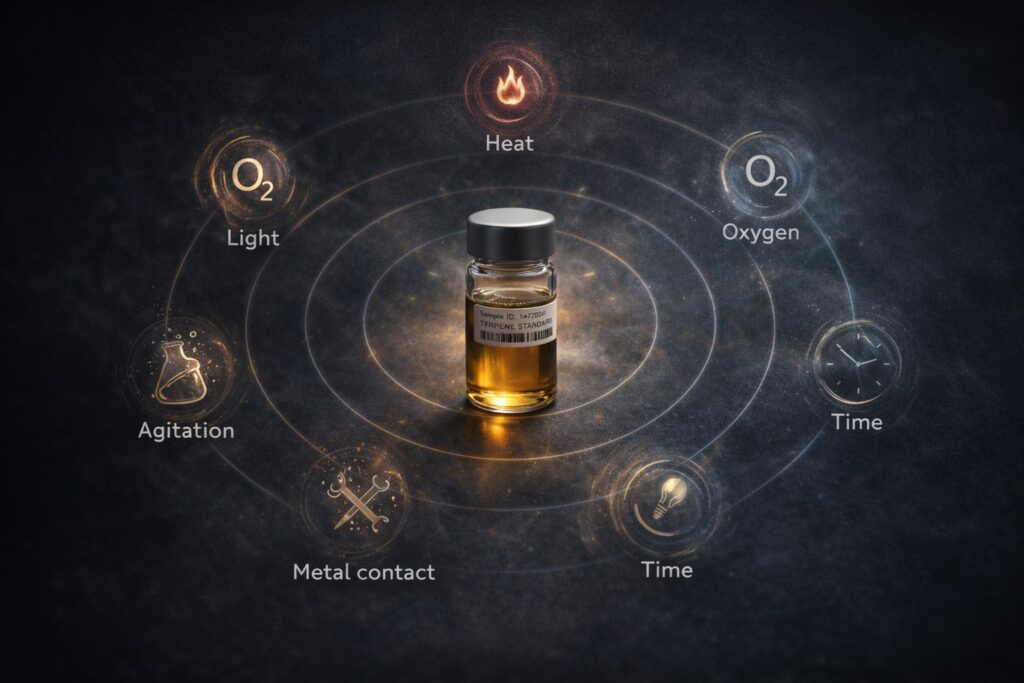
Many teams treat flavor as something that is finalized once a product leaves the production line. In reality, terpene systems continue to evolve during storage, transport, and shelf life.
Time itself is an active variable. As products sit, subtle chemical changes reshape aroma and flavor, even when no obvious contamination or failure occurs.
This slow evolution is one of the most underestimated causes of flavor drift.
Oxygen Exposure Changes Terpene Balance
Terpenes are highly sensitive to oxygen. Even small amounts of air exposure during blending, filling, or storage can initiate oxidation.
Oxidation does not usually create immediate off-flavors. Instead, it gradually dulls brighter notes and shifts balance toward heavier, less expressive components.
Over time, the profile loses definition rather than failing outright.
Packaging Plays a Larger Role Than Expected
Container materials influence how much oxygen, light, and heat reach a finished product. Permeable packaging allows slow exchange with the environment, accelerating drift.
Clear containers also expose terpenes to light, which can further degrade volatile compounds.
Even when formulations remain stable, packaging choices can quietly reshape flavor.
Storage Conditions Are Rarely Uniform
Temperature fluctuations during warehousing and transport introduce additional stress. Products may cycle between warm and cool environments multiple times before reaching consumers.
These fluctuations accelerate volatility loss and oxidation, especially in terpene-heavy products.
Because storage conditions vary outside controlled facilities, drift often appears uneven across regions or channels.
Time Amplifies Small Differences
Minor differences in terpene composition, heat exposure, or packaging rarely matter immediately. Over weeks or months, those differences compound.
What began as a barely perceptible variation becomes a noticeable change in flavor.
Time does not create drift on its own. It reveals it.
Why Drift Is Hard to Trace Backward
By the time drift is detected, the original cause is often several steps removed. Storage conditions have changed. Batches have moved. Variables overlap.
This complexity makes oxidation-driven drift feel unpredictable when it is actually systematic.
Brands that account for time and environment upstream reduce surprises downstream.
Cannabinoid Interaction Effects
Terpenes Do Not Behave the Same in Isolation
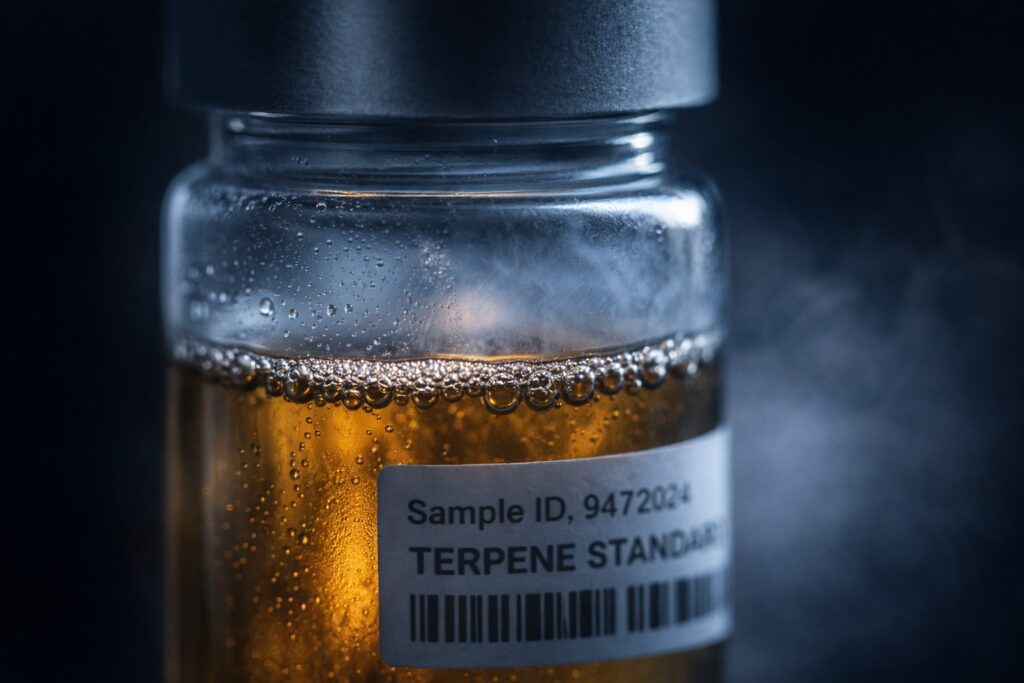
One of the most overlooked contributors to flavor drift is how terpenes behave once they interact with cannabinoids. Aroma testing often happens in isolation, on blotter strips or in concentrated samples.
Those conditions remove the matrix that finished products actually operate in. Once cannabinoids enter the system, terpene expression changes.
Drift often emerges at this intersection.
The Cannabinoid Matrix Alters Volatility
Cannabinoids influence how terpenes volatilize and carry flavor. Ratios, viscosity, and carrier materials all affect how aroma compounds release under heat or during consumption.
Small shifts in cannabinoid composition can amplify or suppress certain terpene notes. When this interaction is not accounted for, flavor can drift even if terpene inputs remain consistent.
What smelled balanced alone may behave differently once blended.
Ratio Sensitivity Increases Over Time
As products age, cannabinoids and terpenes do not degrade at the same rate. This uneven change alters their interaction.
Over time, terpene dominance can shift, changing how the profile is perceived. The experience feels different even though nothing obvious has “gone wrong.”
This effect is especially noticeable in products with high terpene loading.
Why Aroma Tests Miss These Effects
Aroma testing captures potential, not performance. It cannot predict how terpenes will express once cannabinoids, heat, and time are introduced.
Brands that rely exclusively on aroma evaluation often discover drift late, after products have scaled or sat in market.
Finished-product testing reveals these interactions early.
Interaction Effects Are Format-Specific
The way terpenes interact with cannabinoids varies by product type. Vapes, edibles, concentrates, and infused flower all present different matrices.
A terpene system that feels stable in one format may drift in another if interaction effects differ.
Understanding these differences helps brands design terpene systems that hold up across SKUs.
Drift Often Emerges Where Systems Overlap
Flavor drift rarely comes from a single cause. Cannabinoid interaction effects often compound with heat exposure, oxidation, and complexity.
When multiple stressors align, drift accelerates.
Recognizing interaction effects allows brands to intervene earlier, before adjustments become reactive.
Supplier Variability and Inconsistent Inputs
Flavor Drift Often Starts Upstream
When flavor drift appears, teams often look inward first. They review formulas, processes, and equipment. Less often do they look upstream at ingredient variability.
Terpene inputs, in particular, can shift subtly between batches even when names and specifications remain the same.
Those small shifts compound over time.
Batch-to-Batch Variation Is Not Always Obvious
Terpenes are agricultural by nature. Source material changes with season, cultivar, and handling. Even well-controlled processes produce natural variation.
When suppliers adjust blends quietly to maintain aroma targets, buyers may not notice until performance changes downstream.
This quiet adjustment is one of the most common contributors to drift.
Incomplete COAs Hide Meaningful Differences
Certificates of Analysis often present terpene composition in simplified form. Minor components may be omitted, grouped, or rounded.
While these omissions seem insignificant, they can alter how profiles behave under heat and over time.
Without detailed documentation, buyers lose visibility into what actually changed.
Inconsistent Refinement Increases Sensitivity
Variability in refinement and filtration affects viscosity, stability, and volatility behavior. If these steps vary between batches, finished products respond differently to the same conditions.
Brands that experience unexplained drift often trace it back to changes in upstream processing they were never informed about.
Consistency depends on supplier discipline as much as formulation.
Why “Equivalent” Inputs Still Drift
Suppliers sometimes substitute “equivalent” terpene lots to maintain availability. While aroma may match closely, performance characteristics can differ.
These substitutions introduce new variables into systems already under stress from heat and time.
Drift accelerates when equivalence is defined by smell alone.
Upstream Transparency Slows Drift Downstream
Brands that demand clear batch documentation and change disclosure experience less drift. They detect variation earlier and adjust deliberately.
Those that operate on trust alone often discover drift after it reaches consumers.
Upstream clarity acts as an early warning system.
How Brands Can Reduce Flavor Drift

Design for Stability, Not Just Aroma
Reducing flavor drift starts at the design level. Terpene systems built for immediate impact often sacrifice long-term stability.
Brands that prioritize structural balance, volatility alignment, and interaction with cannabinoids create profiles that age more predictably.
Stability is not the absence of flavor. It is flavor that holds together under stress.
Account for Cumulative Heat Exposure
Heat management should consider total exposure across the product lifecycle, not just peak temperatures.
Mapping every thermal step, from processing through consumer use, helps teams identify where volatility loss accumulates.
Reducing dwell time and unnecessary reheating slows drift significantly.
Simplify Overbuilt Terpene Systems
Reducing ingredient clutter lowers sensitivity to oxidation, heat, and interaction effects.
Simpler terpene systems with clear top, mid, and base roles tend to maintain balance longer.
Simplification does not flatten flavor. It removes noise.
Test Finished Products Over Time
Early aroma testing should be paired with finished-product evaluation across realistic holding periods.
Testing at multiple time points reveals drift patterns before products scale widely.
Time-based testing turns surprises into data.
Demand Upstream Transparency
Clear batch documentation, detailed COAs, and change disclosure reduce blind spots.
Brands that work closely with disciplined suppliers detect variation earlier and adjust deliberately.
Transparency upstream slows drift downstream.
Why Flavor Drift Is Predictable, Not Inevitable
Flavor drift feels mysterious when it appears gradually and without obvious triggers. In reality, it follows patterns.
Heat exposure, overbuilt systems, oxidation, cannabinoid interaction, and supplier variability interact over time.
Brands that map these forces reduce drift by design rather than reaction.
In a market where consistency signals quality, controlling drift protects trust.
Frequently Asked Questions About Flavor Drift
While some change over time is natural, brands can significantly reduce drift through heat-aware design, simplification, time-based testing, and transparent sourcing.
Yes. Subtle batch-to-batch differences and undocumented adjustments upstream are common contributors to drift.
Yes. Oxygen exposure, light, temperature fluctuations, and time all influence how terpene systems evolve during storage.
No. Overbuilt terpene systems tend to drift faster because they introduce more volatility and interaction points.
Vapes often reveal drift faster because vaporization magnifies volatility loss. However, edibles, concentrates, and infused products can also experience drift.
Yes. Flavor drift often occurs without intentional reformulation due to cumulative heat exposure, oxidation, ingredient variability, and interaction effects.
Flavor drift is a gradual change in how a product tastes over time. It differs from random batch variation because it moves consistently away from the original experience.